
My dad managed to send some letters in the immediate wake of significant events, in this case, a few days following the Normandy landing that put the Allies on the path to the final defeat of the Nazis.
It probably will interest some that my dad felt like the general public back in the states would be more informed about what had happened on June 6th, 1944. He also was puzzled about how the Catholic Church (he was Episcopalian) seemed to be a disinterested party in such a conflict, perhaps even in the rise of Mussolini.
As he says, avoiding any mention of what is happening on any war front risked having the letter censored. I recall sorting and organizing a collection of soldier letters written to a kindly older lady who would write back to them, keeping their spirits up. This was while working at the Michigan Historical Archives in Ann Arbor while obtaining my masters’ in Library and Information Science. Anyway, occasionally this woman’s correspondents would be a little careless in what they mentioned, resulting in a carefully snipped hole or strip appearing in the middle of their text, but imagine my amusement with one WWII G.I. who was so regularly inclined to slip that one letter consisted solely of a thin paper outline, the entirety of the letter having been sacrificed to the censor’s scissors.
9 June [1944]
England
Dear Folks,
Now that the papers are pretty nearly all bent on providing as much information as possible on the operations on the beaches of France I suppose you know more about the situation than I do. Life here rolls along pretty much the same as it always did and the invasion is far away seemingly in both time and space. Obviously, what I do know I can’t write so it is best as usual that I disregard everything military.
It is natural that everyone, including soldiers, should dream of the day when the war is over and if any one thing might be said of the second front is that it definitely leads everyone into the frame of mind that the beginning of the end is in sight. It is logical to say, I believe, that the Allies are definitely on that road especially when we think back to the days of Dunkerque [sic]. However, it seems to me that the gains we have made have been based more than on the bonds and such monetary “sacrifices” of the people who are earning more than they know what to do with—but in the faith that a great many soldiers, statesmen, and just plain people had in their way of life. I shall probably never be sure if my own was strong enough for circumstances have never tested it. However, I am still feeling a little unhappy about the weakness of the church in the present world conflict. It is often contended that the church is too large an organization to take notice of a moment of indiscretion on the part of mankind, but it appears now that the Vatican is too small—the world too large. I would almost be willing to wager that you will find a great many people feeling that somehow the church had failed—that in refusing to take sides for fear of appearing to favor war, that they (those who form the policy) perverted the eyes of the church away from the seemingly important thesis that physically speaking the church should be able to recognize right and wrong and to apply what force is necessary to set things aright.
I’m going to try to write more often but I won’t promise anything. I have been hearing from you rather regularly but not from anyone else very often. Mail moves spasmodically over here—now good, then poor.
Well, ‘tis supper time so I guess I’ll be going on up the road.
Till later then, be good,
Love,
Bill
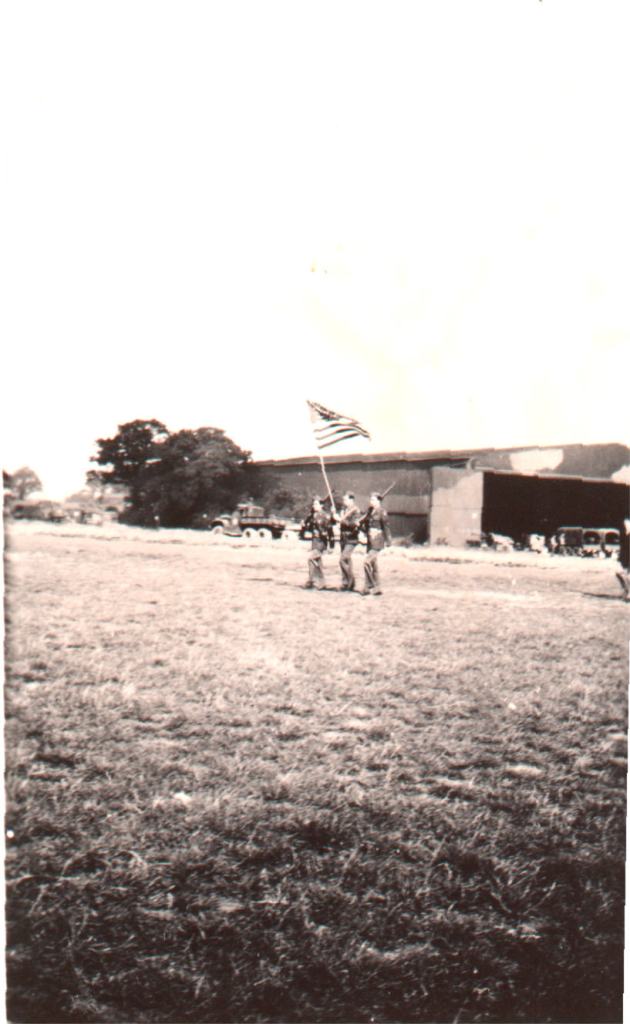
Hethel Air Base, Norfolk, England
 Jabber and Fuss